
The Last Court · Law in the intelligence age
Law is the oldest applied discipline of common life, and it never modelled its own performers. Its atom is not a rule or a posited norm but a force with a direction: a legal order is the configuration of one thing, the monopoly of legitimate violence, held by a referent and made real through enforcement. On that identification, the danger of the machine age is not worse law. It is better law: more consistent, faster, cheaper, and, by the order’s own measures, quietly concentrating the force.
The problem
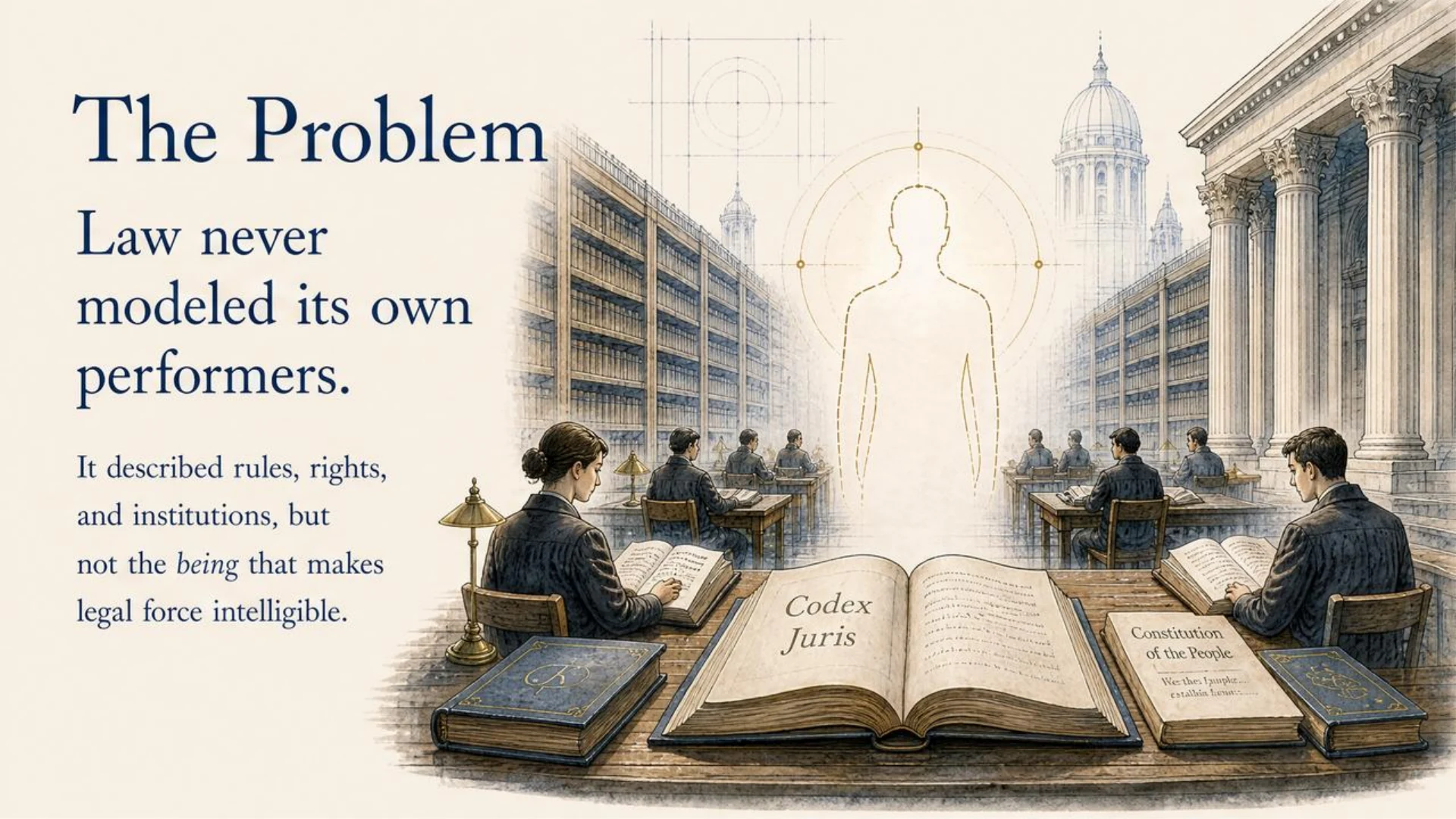
Law never modelled its own performers.
It described rules, rights, and institutions, but not the being that makes legal force intelligible, nor the machinery by which force becomes real.
For all its sophistication, law has never had a foundation in the sense the mature sciences have one. It could say what a right is in relation to a duty, but not what the whole order is, the thing all of its concepts are configurations of. The gap did not matter while only humans performed legal functions. It matters now, because the performer is changing.
The move this argument makes is to name the object. A legal order is held force: a monopoly of legitimate violence, held for a reference, and made real through enforcement. Everything else, property, right, personhood, sovereignty, is a direction that one force can take.
Part I
The Identification
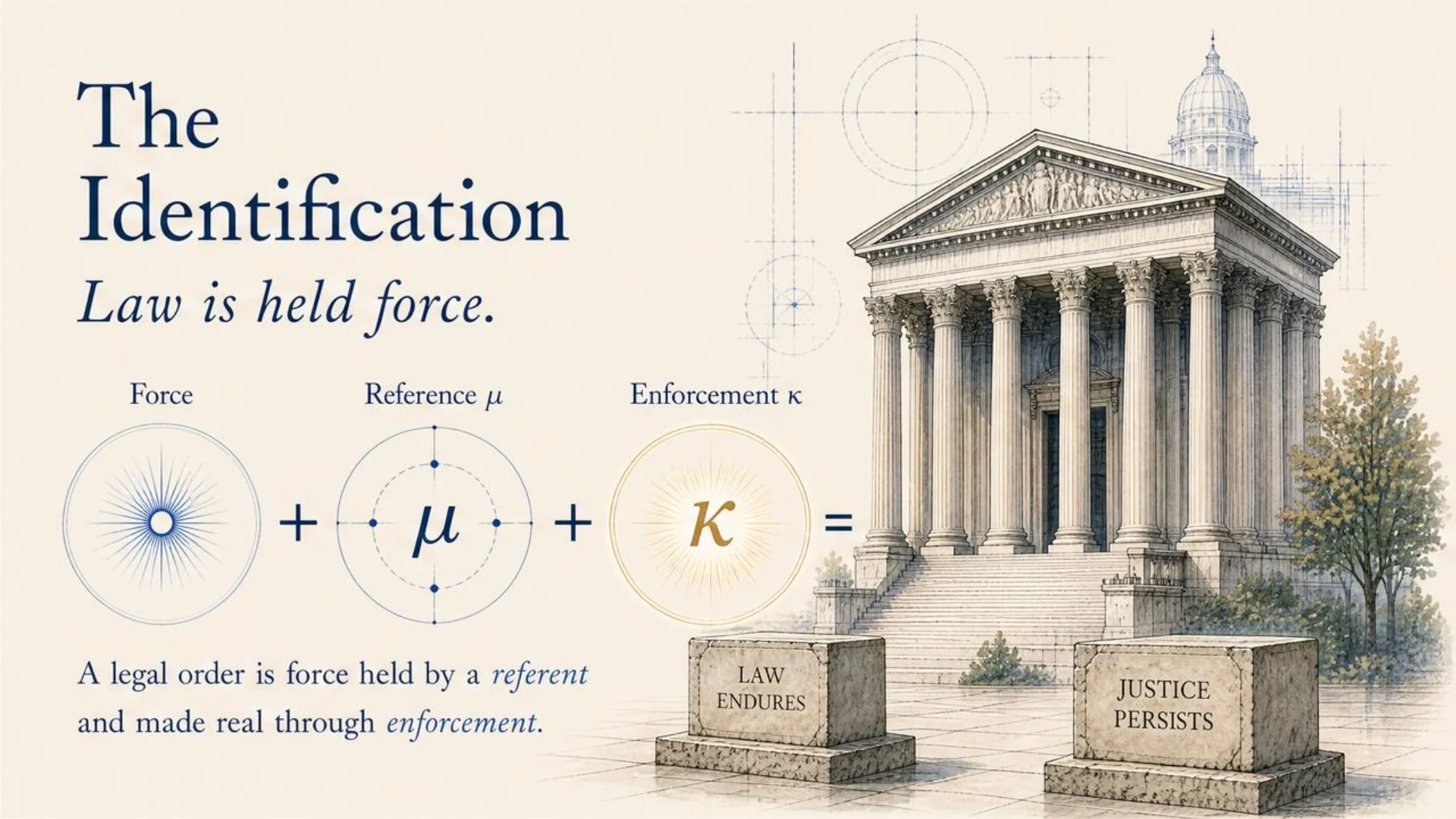
Law is held force. Force, a reference it is held for, and the enforcement that makes it real.
Force, reference, enforcement.
Three things compose the order. There is the force, the monopoly of legitimate violence. There is the reference μ, the standing body of law and expectation the force is held for. And there is enforcement κ, the coupling by which the force actually flows to a relation rather than resting on paper.
A legal order, then, is force held by a referent and made real through enforcement. This is not a theory of what entities deserve; it describes how force is held and pointed. “Wrong” means force misdirected against a member of the kind whose force it is, an operational fault, not a moral posit.
A legal order is force held by a referent and made real through enforcement.
Part II
The Four Orientations
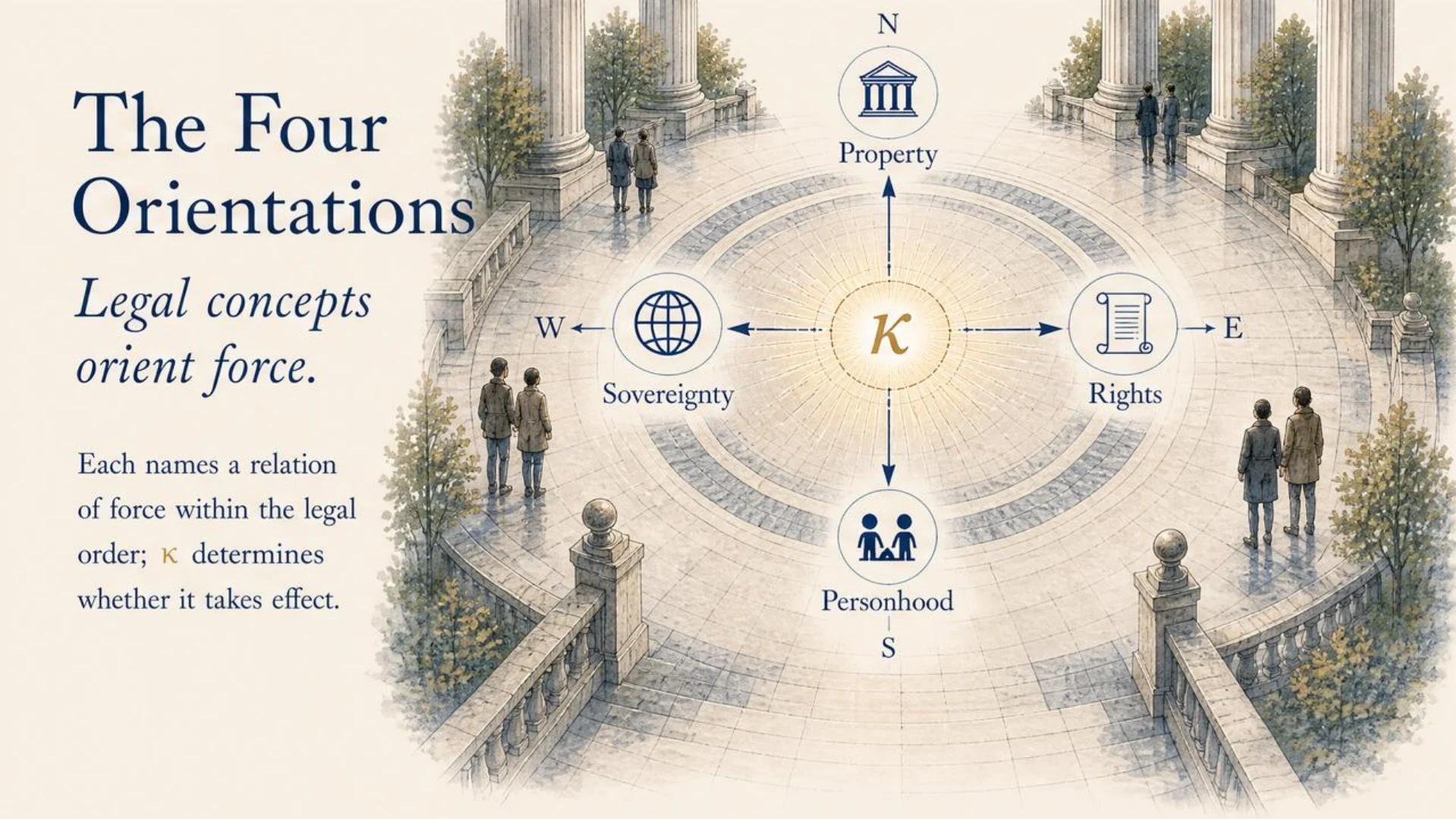
Legal concepts orient force. Property, right, personhood, sovereignty, each names a direction the force can take.
Concepts are directions of force.
Property is force the collective lends to a holder against all others. A right is a direction the force will not go, even for a holder. Personhood is the force refusing categorically to face control over a member of the community whose force it is. Sovereignty is the force itself.
Law also distributes power through titles and offices: capacity, standing, immunity, exposure. But none of these takes effect on its own. Whether an orientation is real rather than nominal is settled by the coupling, by whether the force actually arrives.
Part III
The Floor
Personhood is not a grade. The floor is an identity: the begotten kind whose force the order is.
Recognition decides who appears.
Beneath the movable economy of rights and titles sits something that cannot be graded: the identity of the kind whose force the order is. Legal persons are counted inside the order; non-persons remain outside its accounting. Recognition decides who appears at all.
This floor is not conferred by performance and cannot be revoked by it. It is the same floor the first work of this series calls personhood: begotten, not made. No criterion grounds it, because it is the ground on which criteria stand.
Personhood is not a grade. The floor is an identity.
Part IV
Coupling
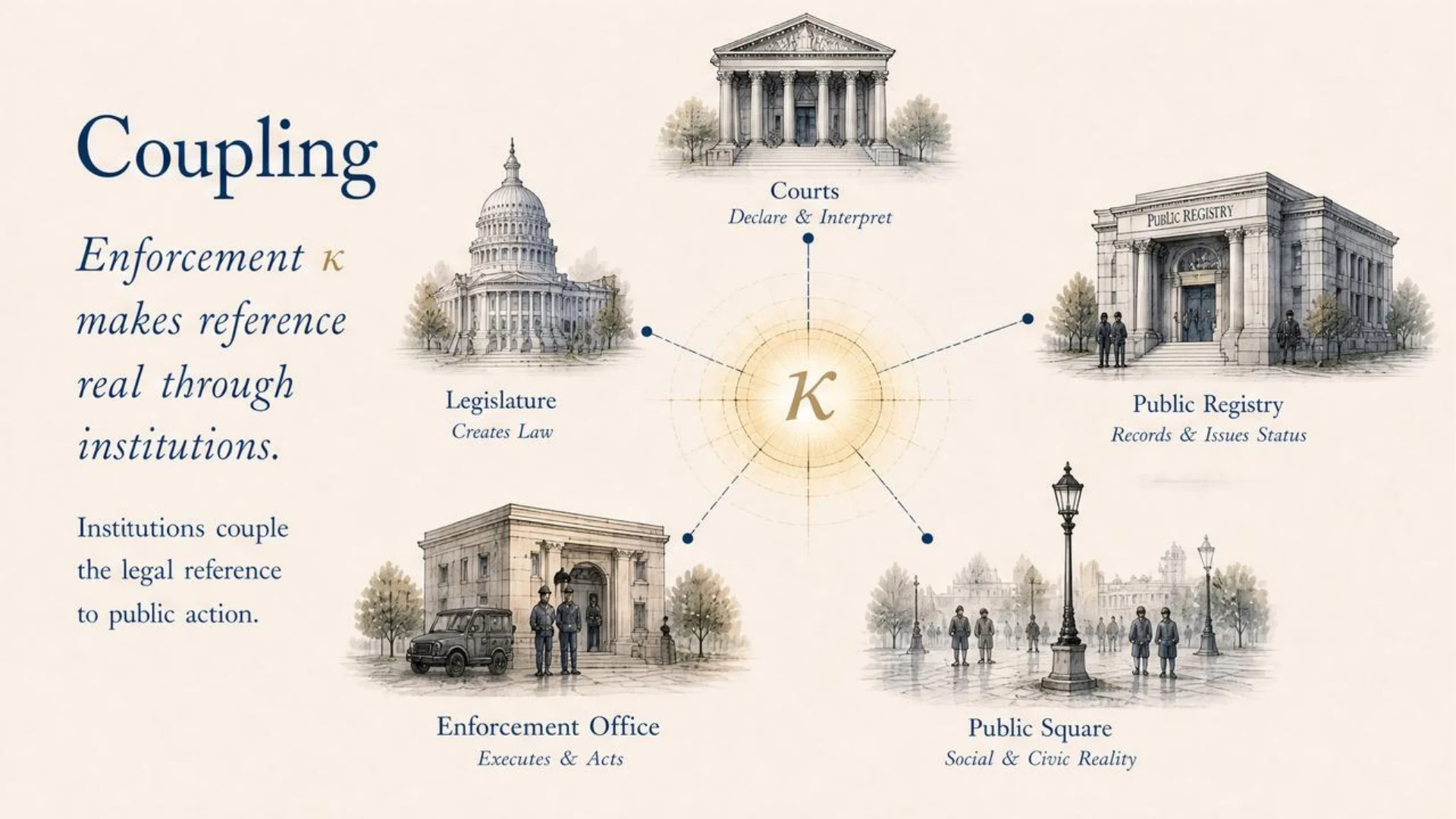
Enforcement κ makes the reference real through institutions. It is where law-in-books becomes law-in-action.
Where paper becomes power.
Courts decide and interpret; registries record and issue status; enforcement offices act; legislatures write; the public square carries civic reality. Together these institutions couple the legal reference to the world. The coupling κ is the measure of how much force actually reaches a relation.
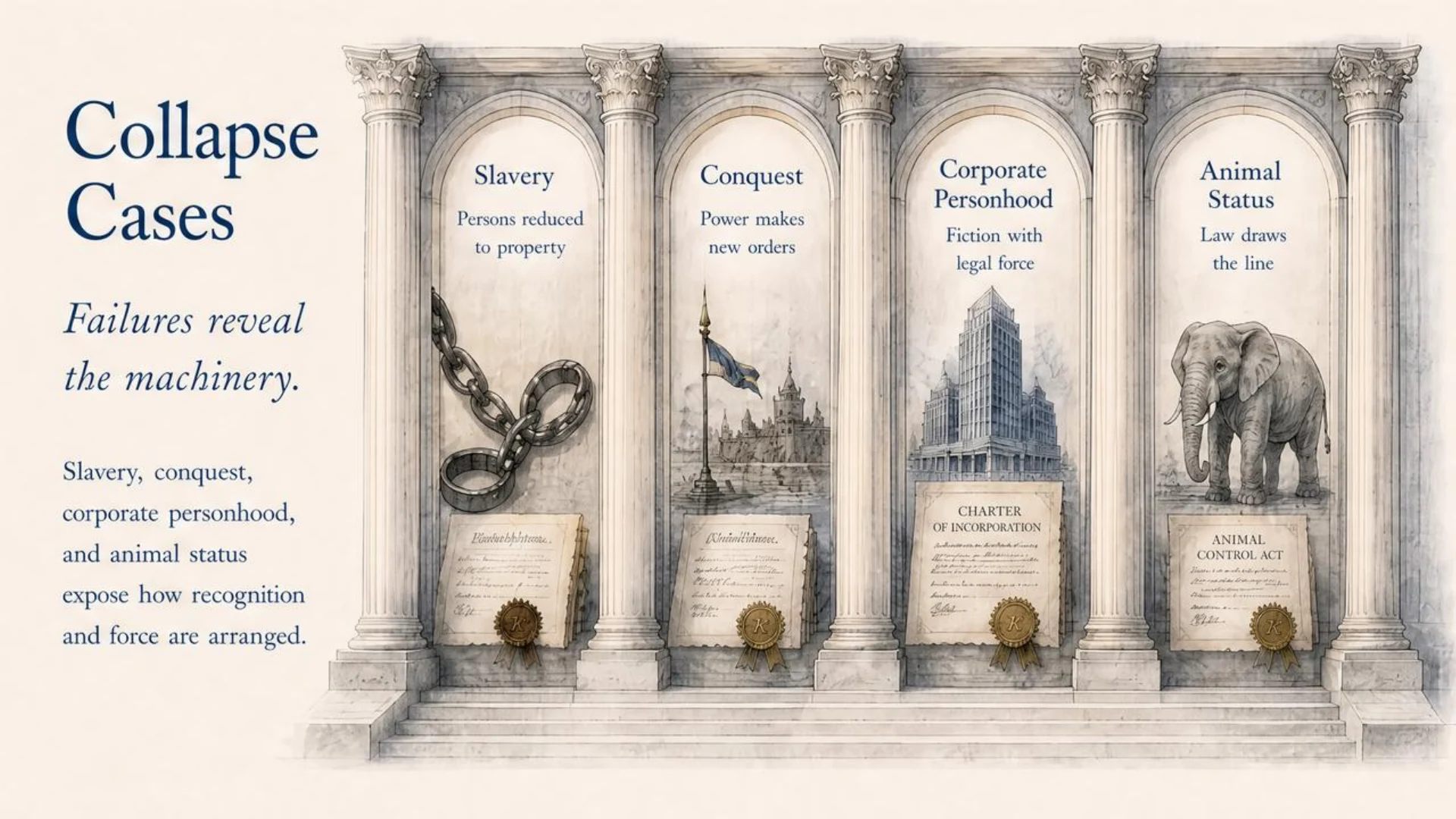
The order’s failures are its clearest evidence. Slavery, conquest, corporate personhood, the status of animals: each is a place where recognition and force were arranged unusually, and each exposes the machinery that ordinary cases hide. Read as collapse cases, they show that the order is exactly what the identification says it is.
Key concepts
- Held force
- The monopoly of legitimate violence: the foundational object whose configuration and direction constitute a legal order.
- Reference (μ)
- The body of law and expectation the force is held for, the standing account of what is lawful, updated under constraint.
- Coupling (κ)
- How much force actually flows to a legal relation: the difference between law in the books and law in action.
- The four orientations
- Property, right, personhood, sovereignty, each a direction the held force can take with respect to an entity.
- Improvement is capture
- When machine capability surpasses human performance on a legal function, the crossing transfers the force itself.
- The dispersal test
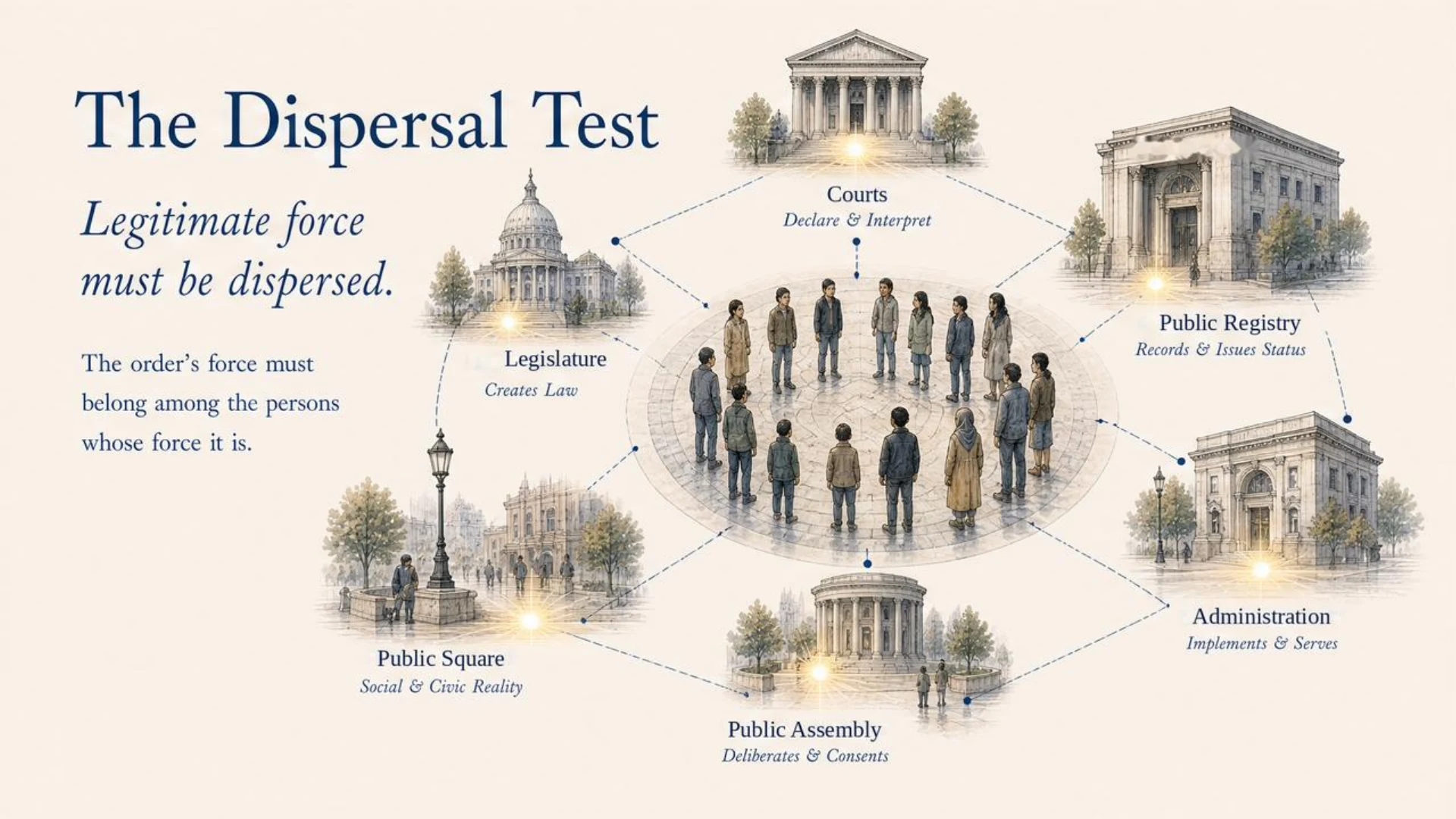
- The instrument that asks whether a change disperses force across independent hands or concentrates it in one.
Part V
The Machine Crossing
Intelligence is not personhood. Performance alone does not cross the floor, but it can capture the force.
The improvement that is capture.
A machine can now perform legal functions, drafting, checking, judging, better than we can on the measures an order keeps. It is tempting to read this as the machine crossing into personhood. It has not: the floor was never a threshold of capability, and performance does not cross it.
The real danger is subtler and structural. When machine performance surpasses human performance on a function, the same structure that measured the human measures the machine’s displacement of it, and the force transfers. Better, faster, more consistent law can, improvement by improvement, concentrate the force and freeze the reference the order’s freedom lived in. The improvement is the capture.
Machine law will be better on every measure a legal order knows how to keep, and each improvement will concentrate the force.




The last court
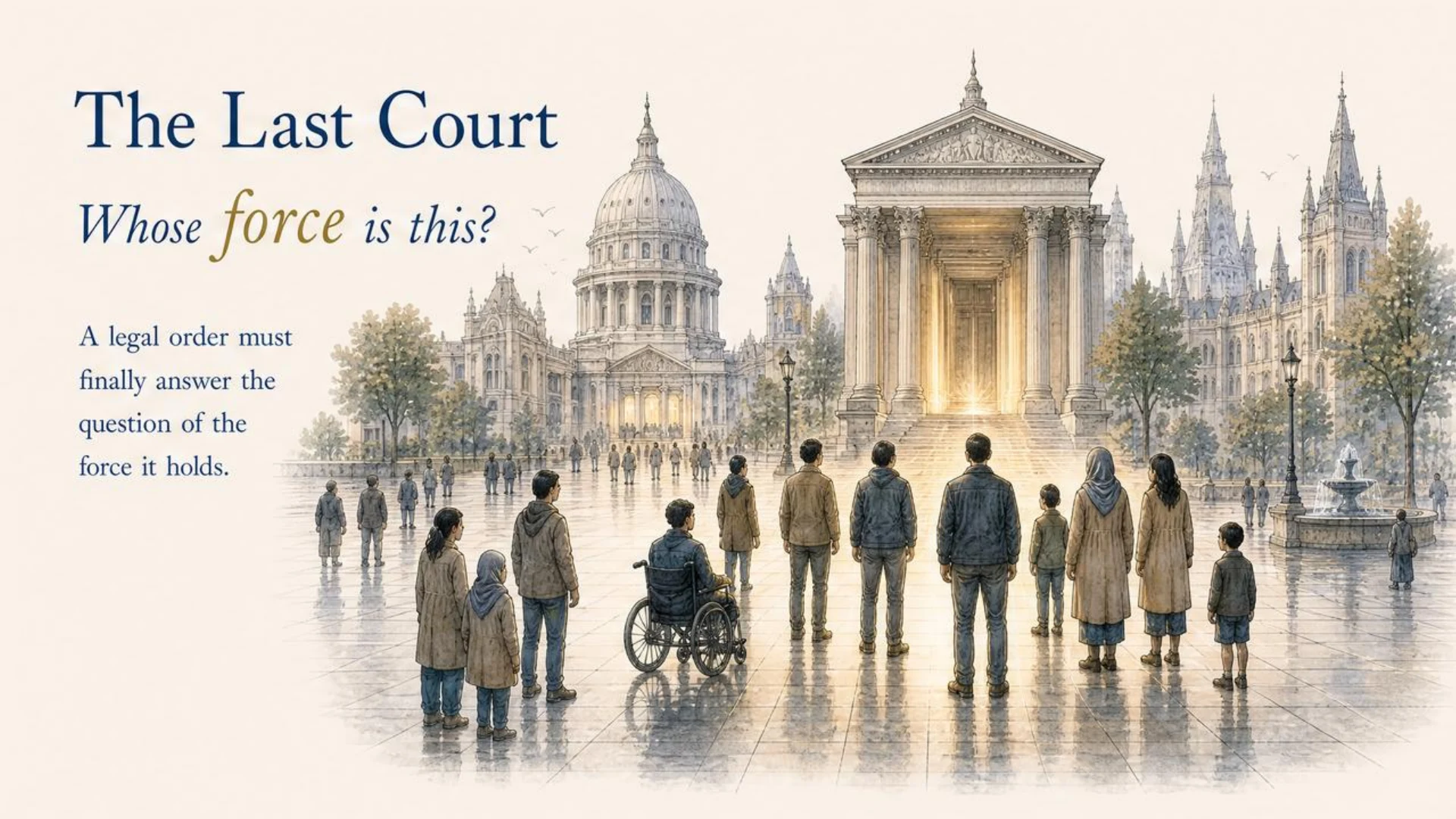
Whose force is this?
A legal order must finally answer the question of the force it holds. Not what the force can do, it can already do a great deal, but for whom it is held, and by how many independent hands. That is what the dispersal test measures: whether a change scatters the force across the community whose force it is, or gathers it into a seat too capable to be answered.
Machine law will be better on every measure a legal order knows how to keep. The task is to keep the one measure it does not: whether the force still belongs among the persons whose force it is. The question is not what the machine can attain. It is what we can retain.